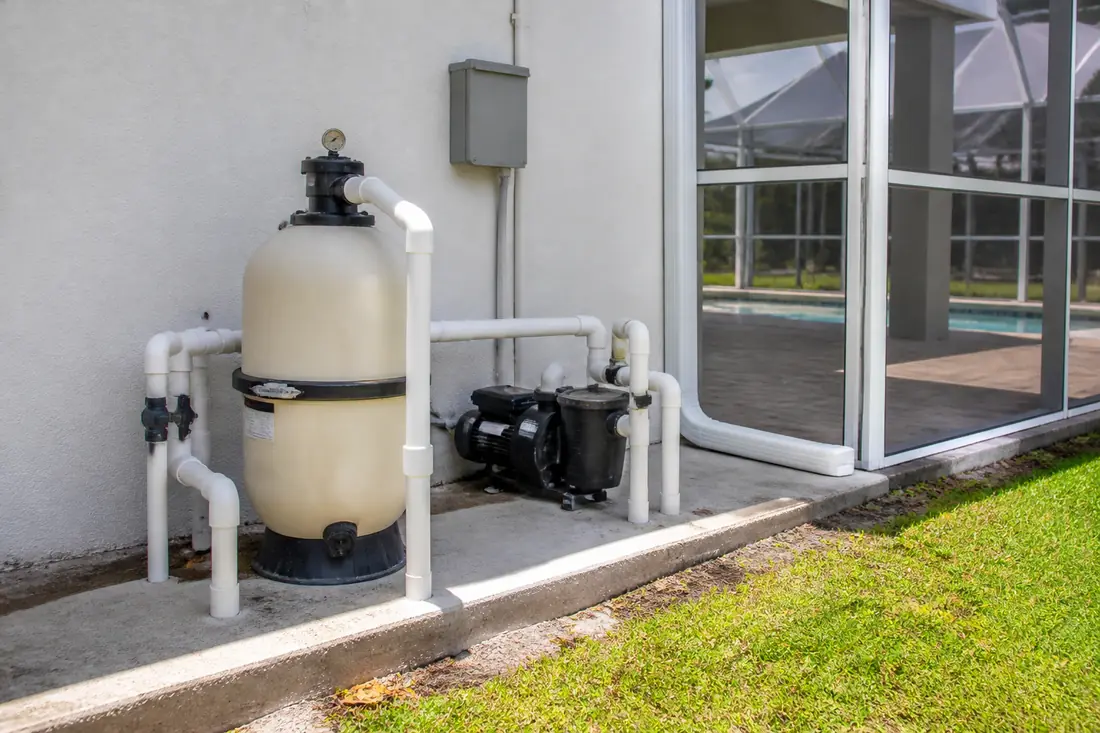
The question usually arrives in the middle of somebody else’s job. A pool cage is coming down for a rebuild, or going back up after a storm, and the crew needs to know what happens to the two lights and the fan that were fixed to the old frame. Or an electrician looks at the pump, which has been wired straight into a disconnect for fifteen years with no GFCI anywhere near it, and says it needs one now.
So the homeowner goes looking for the rule. Florida publishes its building code online, free, and a reasonable person types in “swimming pool” and finds Chapter 45 of the Residential code, which runs to more than twenty sections covering pumps, valves, filters, heaters, gas piping, fittings, barriers and final inspection.
Exactly one of those sections is about electricity. It is nine lines long. It answers one question clearly and then hands everything else to a different document, which is not free, and which the code names without printing.
That is not an oversight, and it is worth understanding rather than working around, because it changes who you should be asking. The parts of this that Florida decides are short and knowable. The parts Florida has deliberately delegated are where the real detail lives, and the only people who can tell you how they apply to your pool are an electrician holding the standard and the inspector who will sign the job off.
Last reviewed: 15 October 2026 against the 2023 Florida Building Code, Residential, Chapters 42 and 45, and the 2023 Florida Building Code, Building, Chapter 27.
The pool chapter has one electrical section, and the chapter next door is empty
Section R4501.16 of the Residential code is headed simply “Electrical,” and it opens by sending most of the subject elsewhere:
Electrical equipment wiring and installation, including the bonding and grounding of pool components shall comply with Chapter 27 of the Florida Building Code, Building.
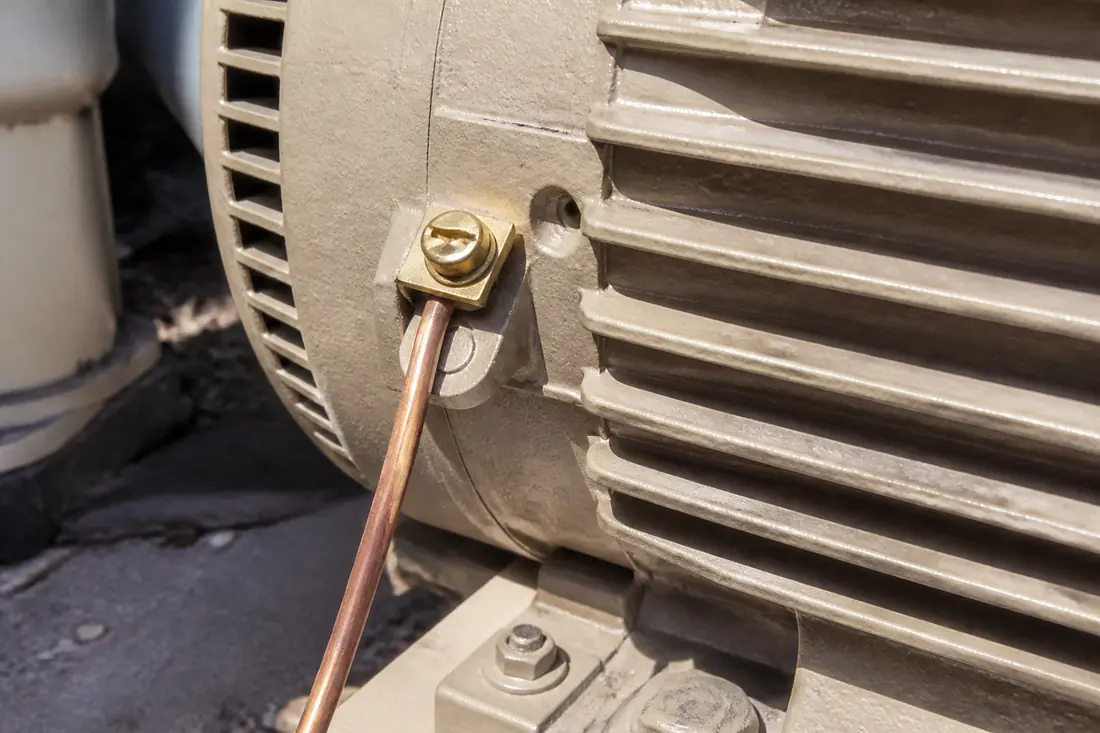
Note what is inside that sentence. Not just wiring. The bonding and grounding of pool components is named explicitly and then referred out. If you came looking for how far bonding has to reach, Chapter 45 has told you where to go and has told you nothing else.
There is a second thing worth checking, because it explains why Chapter 45 is so thin on this. The Residential code has a Chapter 42 titled “Swimming Pools [Electrical Provisions]”. In the model code that chapter carries the pool electrical rules in full. In Florida it reads RESERVED, with no sections in it at all.
Florida took the model chapter out and replaced it with a cross-reference. So there is no second place to look inside the Residential code, and a reader who keeps hunting is hunting for something that was removed on purpose.
What R4501.16 does settle, and it is the question most people are asking
The rest of the section is the useful part, and it sets two different tests rather than one. The first covers the pump:
Outlets supplying pool pump motors connected to single-phase 120-volt through 240-volt branch circuits, whether by receptacle or by direct connection, and outlets supplying other electrical equipment and underwater luminaires operating at voltages greater than the Low Voltage Contact Limit, connected to single-phase, 120 volt through 240 volt branch circuits, rated 15 or 20 amperes, whether by receptacle or by direct connection, shall be provided with ground-fault circuit interrupter protection for personnel.
Read the pump half slowly, because the phrase doing the work is “whether by receptacle or by direct connection.”
Plenty of older pool pumps in Southwest Florida are not plugged into anything. They are hard-wired, out of a weatherproof box or a disconnect on the equipment wall, and there is no receptacle in the circuit to fit a GFCI device into. The common assumption is that the rule is about receptacles, so a hard-wired pump sits outside it.
It does not. The code applies the requirement to the outlet supplying the pump motor, and says in terms that it does not matter whether that outlet is a receptacle or a direct connection. A pump wired straight into a disconnect on a single-phase 120 to 240 volt circuit is covered. If the electrician says the circuit needs GFCI protection at the breaker, that is this sentence, not an upsell.
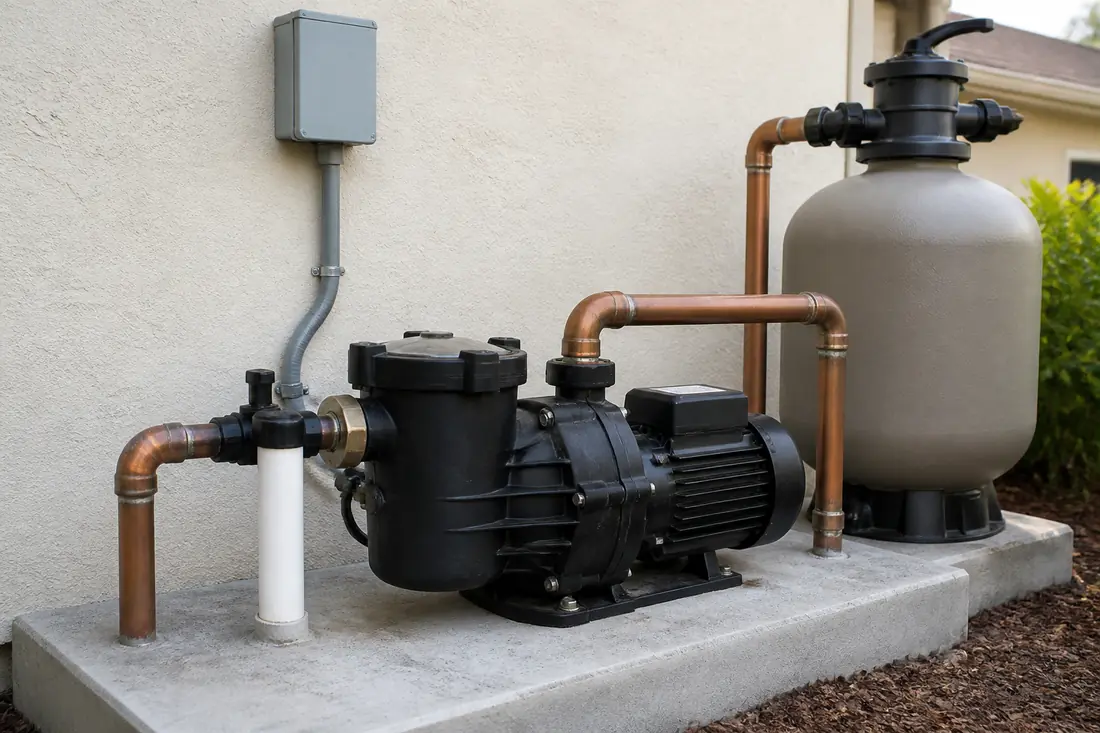
The pump half also carries no voltage threshold beyond the 120 to 240 volt band and no amperage limit. Any single-phase pool pump motor outlet in that band qualifies.
The second test is narrower, and it is the one about lights and fans
Everything that is not a pool pump motor goes through a longer filter. For other electrical equipment and for underwater luminaires, three conditions have to be met together before the GFCI requirement attaches: the equipment has to operate at a voltage greater than the Low Voltage Contact Limit, the circuit has to be single-phase and in the 120 to 240 volt band, and that circuit has to be rated 15 or 20 amperes.
That structure is why a low-voltage pool light and a line-voltage one are treated differently, and why the answer for a transformer-fed fixture is not the same as for one running at 120 volts.
It also contains a term Chapter 45 does not define anywhere else in the chapter. “Low Voltage Contact Limit” is a defined term in the national electrical standard, not in the Florida pool chapter, and this guide does not quote its definition, for the reason set out in the next section. If a fixture is near that boundary, the number matters and it has to come from the standard itself or from the person applying it.

Where the rest of it lives, and why this article does not quote it
Follow the cross-reference and you land in Chapter 27 of the Florida Building Code, Building. Section 2701.1 is equally brief about where authority sits:
The provisions of this chapter and NFPA 70 shall govern the design, construction, erection and installation of the electrical components, appliances, equipment and systems used in buildings and structures covered by this code.
NFPA 70 is the National Electrical Code. Which edition is not left to inference: Chapter 35 of the same code, the referenced standards table, lists the standard as “70—20 National Electrical Code (NEC)”, meaning the 2020 edition, and names Section 2701.1 among the sections that reference it. The pool and spa provisions sit in Article 680 of that standard.
Article 680 is where the bonding questions are actually answered: which metal parts near the water have to be tied together, how far that reach extends from the pool, what conductor does it, and which fittings are small enough to be left out. It is the document an inspector will be working from on a cage job.
This guide quotes none of it, and that is deliberate. NFPA 70 is a standard published by a private body and sold under copyright. It is not posted as free public text the way the Florida Building Code chapters above are. The one freely readable route tried while writing this piece returned the equivalent section from a Texas code rather than the Florida adoption, which would have been a plausible-looking and wrong citation on a Collier County page.
So no bonding distance, conductor size or clearance figure appears anywhere in this guide, because none of them could be taken from a Florida-adopted copy of Article 680 and checked. What appears instead is the chain that tells you where those figures come from, which is the thing most homeowners are missing when an inspector’s note turns up.
Why this comes up on cage work at all
The connection is simple once the chain above is clear. R4501.16 puts the bonding and grounding of pool components under Chapter 27 and therefore under Article 680, and a screen enclosure around a pool is a large, continuous aluminum structure standing a few feet from the water with fixtures screwed into it.
That is why bonding gets raised when a cage is rebuilt rather than when it is left alone. New frame members, a new fastener pattern, lights and fans remounted, sometimes a new slab edge: the physical relationship between metal and water changes, and the question of what has to be tied to what gets asked again.
It is also why the answer is site-specific rather than general. The governing provisions turn on measured distances from the pool and on what the metal is doing, and neither is something a homeowner can settle from a web page. The useful move is to get the question asked early, in writing, by somebody who will be held to the answer.
When do the final electrical and barrier inspections have to happen?
Section R4501.19 is short, and both halves of it are worth knowing before scheduling anything:
Final electrical, and barrier code, inspection shall be completed prior to filling the pool with water.
Exception: Vinyl liner and fiberglass pools are required to be filled with water upon installation.
On a new concrete pool that reads as obvious. On a cage rebuild over an existing pool it is the sentence that decides whether the pool gets drained, and it pairs the electrical sign-off with the barrier sign-off in one requirement.
The exception inverts the rule rather than relaxing it. For vinyl liner and fiberglass pools the code does not merely permit water before the final inspection, it requires those pools to be filled on installation. So which pool you have changes the sequencing question completely, and it is worth establishing before anybody plans a job around draining one.
That pairing matters on cage work specifically, because the enclosure can be the barrier. Section R4501.17.1.11 states that standard screen enclosures meeting the requirements of Section R4501.17 “may be utilized as part of or all of the barrier and shall be considered a nondwelling wall.” So a rebuild can leave both inspections waiting on the same structure.
Whether a particular rebuild triggers a final inspection of that kind is a question for the permit, not for an article. The point is that the code ties water in the pool to inspections being finished, so “we will sort the electrical out afterwards” is not a sequence the code contemplates.
Three rules in Chapter 45 that do get enforced on equipment
Short sections, easy to miss, and all three come up on cage and enclosure work.
R4501.22, equipment installation. “All pool motors and equipment shall be installed in compliance with the manufacturer’s recommendations.” The manufacturer’s instructions are not advisory here. They are incorporated by the code, which means a clearance or mounting requirement printed in a pump manual becomes a code requirement.
R4501.23, accessibility and clearances. “Equipment shall be so installed as to provide ready accessibility for cleaning, operating, maintenance and servicing.” This is the one that catches enclosure work most often. A new cage wall, a screen room extended across an equipment pad, or a privacy screen run tight to the filter can leave equipment that is technically reachable and not readily accessible. It is easier to notice on a drawing than after the frame is up.
R4501.4, approvals. Materials, piping, valves, equipment and appliances have to be of a type complying with the code, or recommended and approved by a nationally recognized testing agency, or conforming to other recognized standards acceptable to the administrative authority. For a light fixture or a fan going into a cage, that is a listing question, and an unlisted fixture is a problem no amount of careful wiring fixes.
There is also a catch-all worth knowing about. R4501.4.2 authorizes the administrative authority, for anything not specifically covered, to require that equipment, materials, methods of construction and design features be proven to function adequately, effectively and without excessive maintenance and operational difficulties. Unusual details end up being judged by the building department rather than by a table.
And for completeness, because heaters sit on the same pad: R4501.15 sends gas piping to the Florida Building Code, Fuel Gas, in the same way R4501.16 sends electrical work to Chapter 27.
What drives the cost of the electrical side of a cage job
There is no meaningful single price here without knowing what is being changed, and the variables are specific enough to be worth listing honestly:
- Whether anything electrical is being moved or only reinstalled in place
- Whether the existing pump circuit already has GFCI protection, and whether that protection is at the breaker or at a receptacle
- How many fixtures and fans are mounted to the frame, and whether they are listed for the location
- Whether the existing wiring is in serviceable condition once the old frame comes off, which nobody can see beforehand
- Whether the work is permitted as part of the enclosure job or as separate electrical work
- What the existing bonding arrangement turns out to be, which on an older pool is frequently undocumented
An older pool in Collier County may have been built under several code cycles’ worth of requirements, and parts of it may be legally existing rather than current. Estimating any of that before the cage is opened up is guesswork.
Four mistakes worth avoiding
Assuming a hard-wired pump is exempt. R4501.16 answers this one directly, with “whether by receptacle or by direct connection.”
Treating “it passed inspection in 2004” as the end of it. Equipment replaced since then was installed under whatever code applied at the time of that work. Replacing a pump is not a grandfathered act.
Reading an electrical answer from the model code rather than the Florida adoption. This is the trap this article ran into itself. Florida reserves Chapter 42 and amends elsewhere, so a provision quoted from the general model code or another state’s version may not be what applies here.
Leaving the bonding question until the frame is up. It is a question about distances and connections between metal parts, and the moment to answer it is when those parts are still accessible.
Questions to ask before the work starts
Ask the electrician which article and section the requirement comes from, and write the answer down. “Article 680” is not an answer; a section number is, and it lets you take the same question to the building department and get a consistent reply.
Ask whether the enclosure scope and the electrical scope are on the same permit or separate ones, and who is responsible for calling the inspection.
Ask what happens to each existing fixture: reused, replaced with a listed equivalent, or removed. A fixture that was acceptable on the old frame is not automatically acceptable on the new one.
And ask the clearance question in the other direction, before the frame is designed rather than after: does the new enclosure line leave the pump, filter and heater readily accessible for servicing, as R4501.23 requires?
If you are planning a pool cage rebuild or frame repair with fixtures mounted to the structure, the electrical questions are cheapest to answer at the drawing stage. Where the plan is to glaze the enclosure rather than rescreen it, the classification changes other things too, which our guide to Florida sunroom categories covers.
This guide explains the code in plain language and is not legal advice. The adopted code in force for your permit, and the building department’s determination for a specific pool, control what is actually required.
Sources
- 2023 Florida Building Code, Residential, Chapter 45 — Swimming Pools, Spas and Hot Tubs. Section R4501.16, “Electrical”, quoted in full above: the reference of electrical equipment wiring and installation, “including the bonding and grounding of pool components”, to Chapter 27 of the Florida Building Code, Building, and the ground-fault circuit interrupter requirement, with its two tests, the 120-volt through 240-volt single-phase band, the 15 or 20 ampere rating applying to the second test, the “Low Voltage Contact Limit” threshold applying to other equipment and underwater luminaires, and the phrase “whether by receptacle or by direct connection” appearing in both. Also Section R4501.19, requiring final electrical and barrier code inspection before the pool is filled with water, together with its Exception, under which vinyl liner and fiberglass pools are required to be filled with water upon installation; Section R4501.22, requiring pool motors and equipment to be installed in compliance with the manufacturer’s recommendations; Section R4501.23, requiring installation to provide ready accessibility for cleaning, operating, maintenance and servicing; Section R4501.4, the approvals provision and its reference to a nationally recognized testing agency; Section R4501.4.2, the administrative authority’s power over items not specifically covered; Section R4501.15, sending gas piping to the Florida Building Code, Fuel Gas; Section R4501.17.1.11, quoted above, under which standard screen enclosures meeting the requirements of Section R4501.17 may be utilized as part of or all of the barrier and are considered a nondwelling wall; and Section R4501.2, defining a private swimming pool in a residential area as containing water exceeding 24 inches in depth.
- 2023 Florida Building Code, Residential, Chapter 42 — Swimming Pools, Electrical Provisions. The chapter is published as RESERVED and contains no sections, which is why Section R4501.16 is the only electrical provision in the Residential code’s pool chapters and why the detail is reached by cross-reference rather than found in the Residential code at all.
- 2023 Florida Building Code, Building, Chapter 27 — Electrical. Section 2701.1, quoted above, under which the provisions of that chapter and NFPA 70 govern the design, construction, erection and installation of electrical components, appliances, equipment and systems. NFPA 70, the National Electrical Code, carries the pool and spa provisions in Article 680. No text of NFPA 70 is quoted in this guide, because the standard is not published as free public text and no verified Florida-adopted copy of Article 680 could be opened while writing it.
- 2023 Florida Building Code, Building, Chapter 35 — Referenced Standards. The National Fire Protection Association entry for standard number 70, listed as “70—20 National Electrical Code (NEC)”, which is the 2020 edition, and the list of referencing sections, which includes Section 2701.1. This is the code’s own statement of which edition of NFPA 70 it adopts, rather than an inference from a publisher’s label.
All four code chapters above were read on 15 October 2026 from the same publisher’s free online viewer, which returned the full chapter text in each case rather than a navigation shell. The Florida Building Commission’s own site at floridabuilding.org did not respond to requests from this machine, so no page of it is cited here.